
Is HNO3 an Acid or Base? Nitric Acid Explained
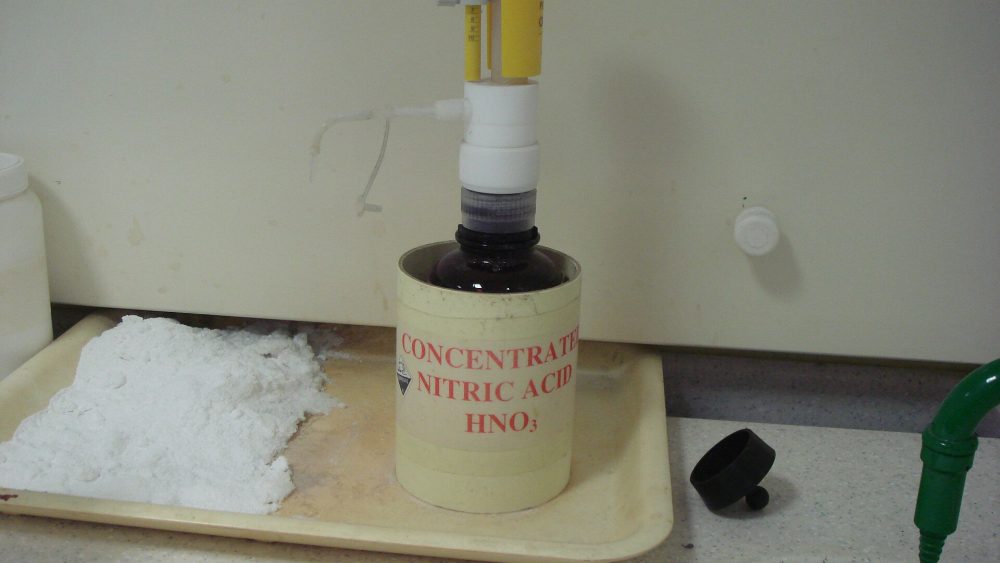
HNO3 shows up in chemistry lessons early and never really leaves. It’s in the first list of strong acids, in titration problems, and in warnings on the lab wall. So is hno3 acid or base? It’s an acid. Its name is nitric acid, and there are several ways to see why, from the formula to a simple indicator test.
Read the formula first
Many common acids start with hydrogen in their written formula. HCl, H2SO4 and HNO3 all follow that habit. The H at the front is a hint that the molecule can give away a hydrogen ion. It isn’t a perfect rule, since water also begins with H, but for a first guess it’s handy.
Common bases look different. Many end in OH, such as NaOH or KOH, and they release hydroxide ions in water. Ammonia, NH3, is the awkward exception, because it’s a base with no OH in sight.
What happens in water
When nitric acid meets water, the hydrogen leaves as a proton and joins a water molecule. In symbols: HNO3 + H2O gives H3O+ and NO3-. The H3O+ is called hydronium, and it’s what makes a solution acidic. The nitrate left behind is a very weak base, so it has little interest in taking the proton back.
Two classic definitions agree here. Arrhenius said an acid raises the hydrogen ion level in water, and it does. Bronsted and Lowry said an acid donates a proton, and it does that too.
A look at the structure
It’s easy to imagine that the hydrogen is attached to nitrogen. In fact, it’s bonded to one of the oxygens. The nitrogen sits in the middle with three oxygens around it, and one of those carries the H. Oxygen pulls hard on the shared electrons, which leaves the hydrogen loosely held.
Once the proton has gone, the negative charge spreads over all three oxygens. Spreading a charge makes an ion more stable, and that’s a big part of why the proton leaves so willingly.
How you’d test it
In a supervised lab, a drop of dilute nitric acid turns blue litmus paper red. A 0.1 mol per liter solution has a pH of about 1, since practically all of the acid has given up its protons. Add a base such as sodium hydroxide, and the two neutralize each other: HNO3 + NaOH gives NaNO3 + H2O. You end up with sodium nitrate and water.
It fizzes with carbonates as well. Put it on a chip of marble, and carbon dioxide bubbles off. A base wouldn’t do that.
Can it ever act as a base?
Surprisingly, yes, in one special case. When nitric acid is mixed with concentrated sulfuric acid, the sulfuric acid is the stronger of the two and pushes a proton onto the nitric acid. The result breaks down to form NO2+, called the nitronium ion, which chemists use to add nitro groups to benzene. In that mixture, HNO3 is accepting a proton, so it’s behaving as a base.
If your course hasn’t reached organic chemistry, don’t let this bother you. In water, and in nearly every exam question, the answer is acid.
Where it’s used
Most of the world’s nitric acid goes into fertilizer. It reacts with ammonia to make ammonium nitrate, which gives crops nitrogen. Some goes into explosives, dyes and plastics, and jewelers use it to check whether a metal is gold, because it attacks copper and silver but leaves gold alone.
It’s dangerous stuff. Concentrated acid burns skin and stains it yellow, and the fumes harm your lungs. It belongs in a fume cupboard, with goggles and gloves.
A quick memory aid
Link the name to the formula. Nitrate is NO3-, and adding one hydrogen gives nitric acid. If you can recall that the “ate” ion turns into an “ic” acid, you can work out others too: sulfate becomes sulfuric acid, and phosphate becomes phosphoric acid. For more questions of this kind, compairro.com has short comparisons that are good for revision the night before a test.